
In C, a switch statement is a control flow statement that allows a variable or expression to be tested against a series of values (called cases). It helps simplify multiple if-else conditions when checking for multiple possible values of a single variable.
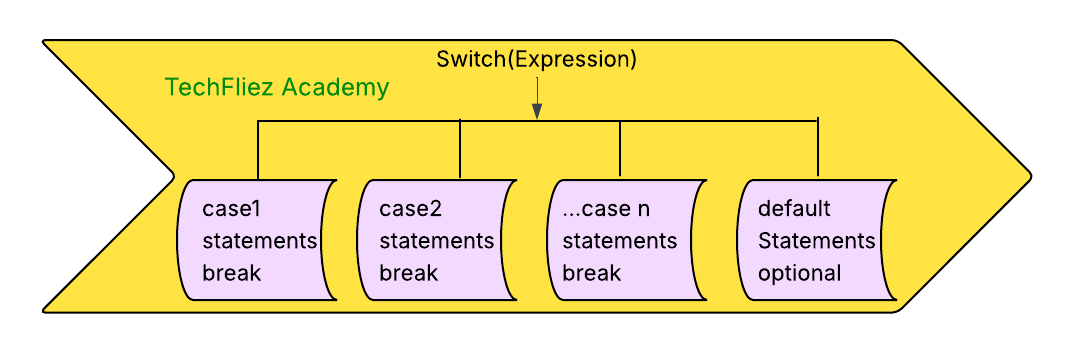
Syntax:
switch (expression) {
    case value1:
        // Code to execute if expression == value1
        break;
    case value2:
        // Code to execute if expression == value2
        break;
    // More cases...
    default:
        // Code to execute if no case matches
}
Key Points:
- switch checks the value of the expression.
- Each case corresponds to a possible value of the expression.
- The break statement ends the switch block after a matching case is found.
- The default case runs if none of the cases match the expression.
Example 1:
#include <stdio.h>

int main() {
     int day = 2;

        switch (day)
        {
            case 1:
                printf("Monday");
                break;
            case 2:
                printf("Tuesday");
                break;
            case 3:
                printf("Wednesday");
                break;

            default:
                printf("Invalid day");
                break;
        }
    return 0;
}
Output:
Tuesday
Example 2:
#include <stdio.h>

int main() {
    enum Day { Sunday, Monday, Tuesday, Wednesday, Thursday, Friday, Saturday };

    // Initialize today as Friday
    enum Day today = Friday;

    switch (today) {
        case Monday:
            printf("Start of the work week!");
            break;
        case Friday:
            printf("End of the work week!");
            break;
        default:
            printf("It's a regular day.");
            break;
    }

    return 0;
}
Output:
End of the work week!
C switch statement – Interview Questions
Q 1: What is the switch statement in C?
Ans: It executes code based on the value of an expression.
Q 2: Which data types are allowed in switch?
Ans: Integer and character types.
Q 3: Why is break used in a switch?
Ans: To prevent execution from falling through to the next case.
Q 4: What is the default case?
Ans: It runs when no case matches the expression.
Q 5: Can a switch work without break?
Ans: Yes, but it causes fall-through behavior.
C Switch Statement – Objective Questions (MCQs)
Q1. Which of the following can be used in a switch statement?
Q2. What is the purpose of the break statement in a switch block?
Q3. What happens if the break statement is missing in a switch case?
Q4. Which keyword is used to specify a block that executes when no case matches?
Q5. What is the output of this code?
int x = 2;
switch (x) {
case 1: printf("One");
case 2: printf("Two");
case 3: printf("Three");}