
C Syntax refers to the set of rules and guidelines that define the structure of valid C programming language code. It determines how programs should be written so that they can be understood and executed by a C compiler. C syntax specifies the correct arrangement of keywords, identifiers, operators, punctuation, and expressions.
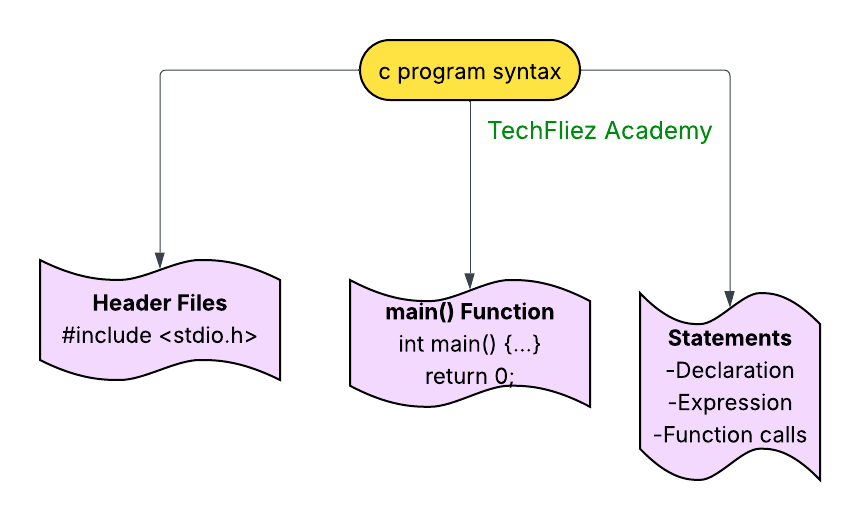
Example:
#include <stdio.h>  // Preprocessor directive to include standard input/output header file

int main() {
    printf("Hello, techfliez.com!");  // Prints "Hello, techfliez.com!" to the console
    return 0;  // Exit the program successfully
}
Explanation:
include<stdio.h>: This tells the compiler to include the standard input/output library that allows us to use functions like printf.
int main(): This is the entry point of every C program. The program starts executing here.
printf(“Hello, techfliez.com!”);: This line prints the message Hello, techfliez.com! to the screen.
return 0;: This indicates that the program has successfully completed and returns control to the operating system.
Create a new line into text
we can create a new line through \n
#include <stdio.h>  // Preprocessor directive to include standard input/output header file

int main() {
    printf("Hello, techfliez.com!\n");  // Prints "Hello, removeload
    printf("Hello World!");
    return 0;  // Exit the program successfully
}
When we run above code then
Hello World!
C Syntax – Interview Questions
Q 1: What is C syntax?
Q 2: Why are semicolons used in C?
Q 3: Is C case-sensitive?
Q 4: What is the role of curly braces {} in C?
Q 5: What is the correct syntax of the main() function?
C Syntax – Objective Questions (MCQs)
Q1. Which of the following is the correct syntax to include a header file in C?
Q2. Every C program must have a function named:
Q3. Which of the following symbols is used to end a statement in C?
Q4. What is the correct syntax to declare an integer variable in C?
Q5. Which of the following lines is a valid C comment?