
In Python, attributes and methods are key to defining the properties and behaviors of objects in a class.
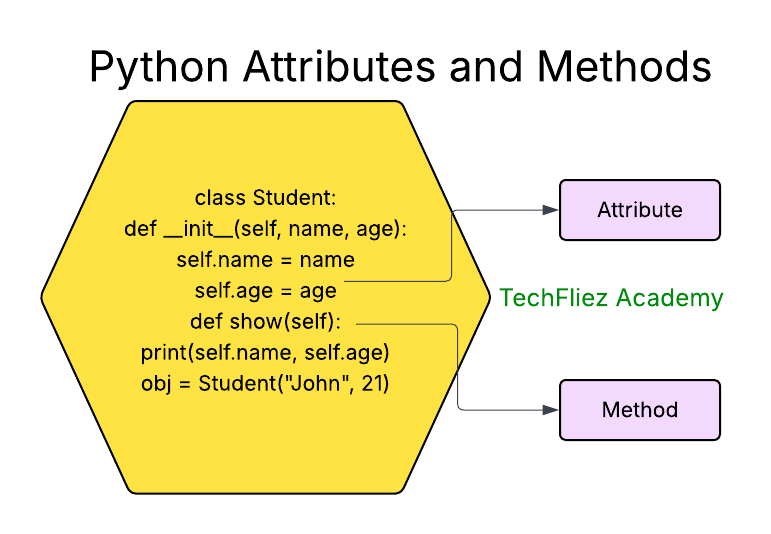
Attributes
Attributes are variables that store data about the object. They can be any data type, such as string, integer, or list. They are usually set up in the __init__ method, which is also called the constructor, of a class.
Types of Attributes
Instance Attributes: These are specific to each object instance and are defined in the __init__ method.
Class Attributes: These are shared across all class instances and are defined outside any method within the class.
Example:
class Car:
    # Class attribute
    vehicle_type = "Car"

    def __init__(self, brand, color):
        # Instance attributes
        self.brand = brand
        self.color = color
create the Object
# Creating two objects of the Car class
car1 = Car("Toyota", "Red")
car2 = Car("Honda", "Blue")

print(car1.brand)         # Output: Toyota
print(car2.color)         # Output: Blue
print(car1.vehicle_type)  # Output: Car (shared class attribute)
Methods
Methods are functions that belong to a class and explain how an object behaves. They enable objects to perform actions and can interact with or change the object’s attributes.
Types of Methods
Instance Methods: These work with instance attributes and are defined with self as the first parameter.
Class Methods: These work with class attributes and use the @classmethod decorator with cls as the first parameter.
Static Methods: These do not change class or instance attributes. They are usually defined with the @staticmethod decorator and do not take self or cls as a parameter.
Example
class Car:
    vehicle_type = "Car"  # Class attribute

    def __init__(self, brand, color):
        self.brand = brand  # Instance attribute
        self.color = color  # Instance attribute

    # Instance method
    def start(self):
        print(f"The {self.color} {self.brand} is starting.")

    # Class method
    @classmethod
    def change_vehicle_type(cls, new_type):
        cls.vehicle_type = new_type

    # Static method
    @staticmethod
    def is_motor_vehicle():
        return True
create a Object
# Creating an instance
my_car = Car("Tata", "White")

# Calling instance method
my_car.start()  # Output: The White Tata is starting.

# Calling class method
Car.change_vehicle_type("Electric Car")
print(Car.vehicle_type)  # Output: Electric Car

# Calling static method
print(Car.is_motor_vehicle())  # Output: True
Python Attributes and Methods – Interview Questions
Q 1: What is an attribute in Python?
Q 2: What is a method in Python?
Q 3: How do you access an object’s attribute?
Q 4: Can a method modify object attributes?
Q 5: What is the difference between class and instance attributes?
Python Attributes and Methods – Objective Questions (MCQs)
Q1. Which of the following is used to access an attribute of an object in Python?
Q2. What will be the output of the following code?
class Test:
x = 10
obj = Test()
print(hasattr(obj, 'x'))
Q3. Which built-in function is used to get all attributes and methods of an object?
Q4. What does the setattr() function do in Python?
Q5. Given the code below, what will obj.method() print?
class Demo:
def method(self):
print("Hello from method")
obj = Demo()
obj.method()