
A for loop in C is a control flow statement used to repeatedly execute a block of code a specified number of times. It is commonly used when you know in advance how many times the loop should run.
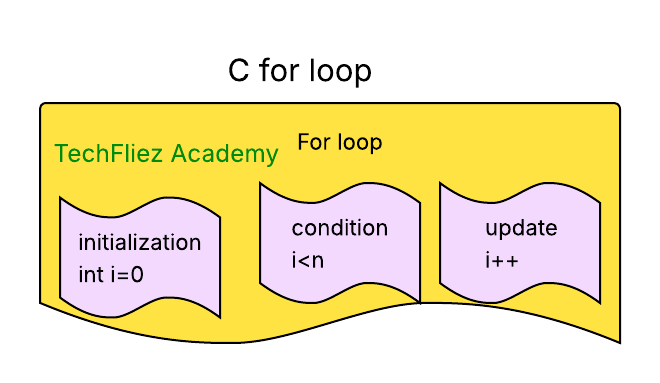
Syntax:
for (initialization; condition; update) {
    // Code to execute repeatedly
}
Explanation:
1. Initialization: Defines and initializes the loop control variable (this is executed only once at the beginning).
2. Condition: The loop keeps running as long as this condition is true.
3. Update: Updates the loop control variable after each iteration (e.g., increments or decrements it).
Example:
#include <stdio.h>

int main() {
        for (int i = 0; i < 5; i++) {
        printf("%d\n", i);
         }

    return 0;
}
Output:
1
2
3
4
Example: Print the table of 2 through for loop
#include <stdio.h>

int main() {
        for (int i = 2; i <=20; i=i+2)
        {
            printf("%d\n", i); // Prints the current value of i
        }

    return 0;
}
Output:
4
6
8
10
12
14
16
18
20
C for loop – Interview Questions
Q 1: What is a for loop in C?
Q 2: What are the three parts of a for loop?
Q 3: Can a for loop run without all three expressions?
Q 4: Can we nest for loops?
Q 5: What happens if the condition is false initially?
C for loop – Objective Questions (MCQs)
Q1. What is the correct syntax of a for loop in C?
Q2. How many times will this loop execute?
for (int i = 0; i < 5; i++) {
printf("%d", i);
}
Q3. What happens if the condition in a for loop is always true?
Q4. In a for loop, which part executes only once?
Q5. What is the output of this code?
for (int i = 1; i <= 3; i++)
printf("Hi ");