
Introduction
One of the most commonly used loops in PHP is the for loop. It is especially useful when you know in advance how many times you want to execute a block of code.
The PHP for loop is simple, powerful, and widely used in real-world applications.
What is a PHP For Loop?
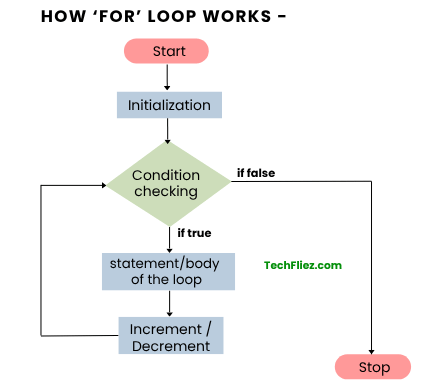
The for loop in PHP is used to execute a block of code repeatedly for a specific number of times.
It consists of three main parts:
- Initialization
- Condition
- Increment/Decrement
Note: The loop runs until the condition becomes false.
Syntax
Basic Syntax:
for (initialization; condition; increment/decrement) {
   // code to be executed
}
Explanation:
- Initialization → sets the starting value
- Condition → checks whether the loop should continue
- Increment/Decrement → updates the loop variable
Examples:
Example 1: Simple Increment Loop
<?php
for ($x = 1; $x < 5; $x++) {
   print $x . "<br/>";
}
?>
Output:
2
3
4
Example 2: Decrement Loop
<?php
for ($x = 5; $x > 1; $x--) {
   print $x . "<br/>";
}
?>
Output:
4
3
2
Example 3: Printing Even Numbers
<?php
for ($i = 2; $i <= 10; $i += 2) {
   echo $i . "<br/>";
}
?>
Example 4: Loop with Multiple Variables
<?php
for ($i = 1, $j = 10; $i <= 5; $i++, $j--) {
   echo "i = $i, j = $j <br/>";
}
?>
Example 5: Nested For Loop
<?php
for ($i = 1; $i <= 3; $i++) {
   for ($j = 1; $j <= 2; $j++) {
       echo "i = $i, j = $j <br/>";
   }
}
?>
Real-Life Example
Scenario1: Multiplication Table
<?php
$num = 5;
for ($i = 1; $i <= 10; $i++) {
   echo "$num x $i = " . ($num * $i) . "<br/>";
}
?>
Why this is useful:
- Common in educational apps
- Helps automate calculations
- Reduces manual work
Scenario 2: Display List of Products
<?php
$products = ["Laptop", "Mobile", "Tablet"];
for ($i = 0; $i < count($products); $i++) {
   echo $products[$i] . "<br/>";
}
?>
Note: Used in e-commerce websites to display items dynamically.
Common Mistakes
1. Infinite Loop
for ($i = 1; $i <= 5; $i--) {
   echo $i;
}
Note: The condition never becomes false.
2. Wrong Condition
for ($i = 1; $i > 5; $i++) {
Note: The loop will never execute.
3. Missing Increment/Decrement
for ($i = 1; $i <= 5;) {
Note: Causes an infinite loop.
4. Using Wrong Comparison Operator
Be careful with <, <=, >, >=.
5. Not Using count() Properly
for ($i = 0; $i <= count($arr); $i++)
Note: This may cause an undefined index error.
Conclusion
The PHP for loop is a powerful and flexible tool for handling repetitive tasks. It provides a clean and structured way to control iterations, making your code more efficient and readable.
PHP for loop – Interview Questions
Q 1: What is a for loop in PHP?
Q 2: Syntax of for loop?
Q 3: When should for loop be used?
Q 4: Can for loops be nested?
Q 5: Is the loop counter mandatory?
PHP for loop – Objective Questions (MCQs)
Q1. for loop is ideal when the number of iterations is ______.
Q2. How many parts are in a for loop declaration?
Q3. Which part of the for loop executes only once?
Q4. Which keyword exits a loop immediately?
Q5. for loop executes the body ______ times when the condition is true.