
1. Introduction
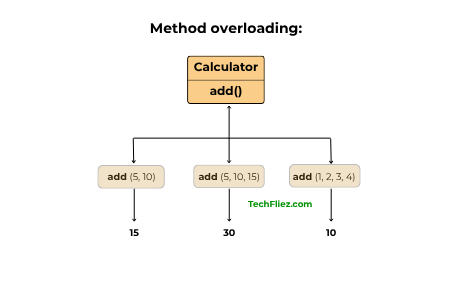
In Object-Oriented Programming (OOP), method overloading refers to the ability to create multiple methods with the same name but with different parameters. In many programming languages like Java or C++, method overloading is supported directly by defining multiple methods with the same name but different argument lists.
However, PHP does not support traditional method overloading in the same way as those languages. Instead, PHP provides special magic methods that allow developers to handle dynamic method calls.
In PHP, method overloading is mainly achieved using the __call() magic method. This method is automatically triggered when a method is called that is not accessible or does not exist in the class.
- PHP does not support method overloading directly.
- Method overloading is implemented using magic methods.
- The most commonly used magic method is__call().
- It allows developers to handle calls to undefined methods dynamically.
2. Syntax
The syntax of method overloading in PHP involves the __call() magic method.
class ClassName {

   public function __call($methodName, $arguments) {
       // code to handle dynamic method calls
   }

}
Explanation:
- __call() → magic method triggered when a non-existing method is called
- $methodName → name of the method that was called.
- $arguments → array containing all parameters passed to the method.
When a method that does not exist in the class then PHP automatically executes the __call() method.
3. Example
class Student {

   public function __call($method, $arguments) {

       if($method == "display") {

           if(count($arguments) == 1) {
               echo "Student Name: " . $arguments[0];
           }

           if(count($arguments) == 2) {
               echo "Student Name: " . $arguments[0] .
                    " Age: " . $arguments[1];
           }

       }

   }

}

$stu = new Student();

$stu->display("John");
echo "<br>";
$stu->display("John", 21);
In this example:
- The method display() does not actually exist in the class.
- PHP automatically calls the __call() method.
- Inside the method, the behavior changes based on the number of arguments.
Output:
Student Name: John Age: 21
Explanation:
Let’s understand how PHP method overloading works step by step.
First, we create a class.
class Student
Inside the class, we define the __call() magic method.
public function __call($method, $arguments)
This method receives two parameters:
- $method → name of the method that was called
- $arguments → array of arguments passed to that method
Next, we check the method name.
if($method == "display")
Then we check how many arguments were passed using:
count($arguments)
If the method receives one parameter, it prints only the name.
If it receives two parameters, it prints both the name and age.
When we call:
$stu->display("John");
PHP cannot find the display() method, so it automatically triggers __call().
Similarly:
$stu->display("John", 21);
Again,__call() handles the method dynamically.
This technique allows developers to simulate method overloading in PHP even though PHP does not support it directly.
4. Real-world Example
Let’s understand a practical example using a Product system in an e-commerce application.
Different product methods may accept different parameters.
class Product {

   public function __call($method, $args) {

       if($method == "productInfo") {

           if(count($args) == 1) {
               echo "Product Name: " . $args[0];
           }

           if(count($args) == 2) {
               echo "Product Name: " . $args[0] .
                    " Price: $" . $args[1];
           }

           if(count($args) == 3) {
               echo "Product Name: " . $args[0] .
                    " Price: $" . $args[1] .
                    " Category: " . $args[2];
           }

       }

   }

}

$product = new Product();

$product->productInfo("Laptop");
echo "<br>";

$product->productInfo("Laptop", 800);
echo "<br>";

$product->productInfo("Laptop", 800, "Electronics");
In this example:
- The productInfo() method does not exist.
- The __call() method dynamically handles the method call.
- The output changes based on the number of parameters passed.
This technique is useful for building flexible APIs and dynamic class behavior.
Output:
Product Name: Laptop Price: $800 Product Name: Laptop Price: $800 Category: Electronics
The same method name produces different results depending on the number of arguments.
5. Conclusion
PHP method overloading allows developers to handle dynamic method calls even though PHP does not support traditional method overloading like some other programming languages.
Using the __call() magic method, developers can create flexible and dynamic classes that behave differently depending on the number or type of parameters passed to a method.
PHP Method Overloading – Interview Questions
Q 1: Does PHP support method overloading?
Q 2: How is method overloading achieved in PHP?
Q 3: What is __call() method?
Q 4: Can PHP methods have optional parameters?
Q 5: Why is method overloading limited in PHP?
PHP Method Overloading – Objective Questions (MCQs)
Q1. PHP method overloading is achieved via ______.
Q2. Method overloading allows ______.
Q3. Overloading is handled ______ in PHP.
Q4. __call() is invoked when ______.
Q5. Method overloading improves ______.