
1. Introduction
Now a days, Everybody is discussing Artificial Intelligence, Machine Learning, and Deep Learning. Many people think it’s a same, but they actually represent different concepts within the same technological field.
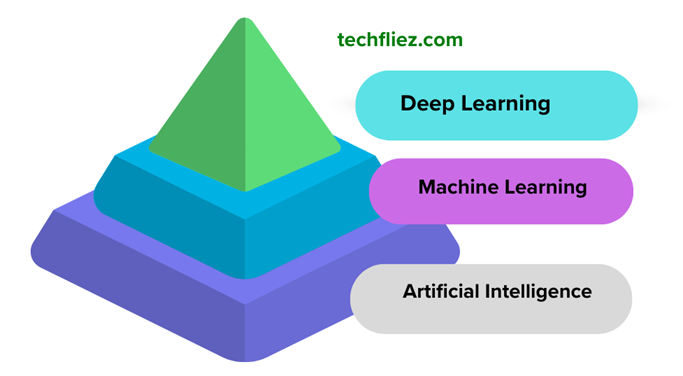
Artificial Intelligence is the broadest concept, while Machine Learning and Deep Learning are subsets of it. I will clearly explain the differences between these technologies is important for developers, students, and businesses who want to use modern intelligent systems.
2. What is the Concept
1. Artificial Intelligence
Artificial Intelligence is a part of computer science and creating machines performing tasks that normally require human intelligence.
These tasks include:
- Learning from experience
- Understanding language
- Recognizing images
- Making decisions
- Solving complex problems
Some AI examples like voice assistants, recommendation systems, chatbots, and self-driving technologies.
2. Machine Learning
Machine Learning is a subset of Artificial Intelligence that enables computers to learn from data without being explicitly programmed.
Instead of writing rules manually, machine learning systems analyze data and identify patterns to make predictions or decisions.
Examples include:
- Spam email detection
- Recommendation systems
- Fraud detection
- Predictive analytics
3. Deep Learning
Deep Learning is inspired by the human brain. It uses artificial neural networks like human biological neural network. Deep Learning is a subset of Machine Learning.
Deep learning models process large amounts of data using multiple layers of neural networks to detect complex patterns.
There are many example of Deep Learning like
- Image recognition
- Speech recognition
- Language translation
- Autonomous vehicles
3. How It Works
You will see the working process of these technologies.
Artificial Intelligence
Artificial Intelligence systems is used to combine different techniques such as:
- Rule-based systems
- Machine learning algorithms
- Data processing
- Knowledge representation
The goal of Artificial Intelligence works as intelligent behavior.
Machine Learning
Machine learning use three main steps:
- Data Collection – It is used to collect large datasets.
- Model Training – Algorithms is used to learn patterns from the data.
- Prediction – The trained model makes predictions on new data.
To accurate predictions there is need more data that model receives.
Deep Learning
Deep learning uses neural networks consisting of multiple layers.
These layers process information step by step:
- Input layer is used to receives data
- Hidden layers are basically use for analyze patterns
- Output layer is used to produce results
Because of these multiple layers, deep learning models can identify very complex patterns in large datasets.
4. Example
Let’s understand the difference with a simple example.
1. Email Spam Detection
Artificial Intelligence
It is used to identifies spam emails.
Machine Learning
Machine learning algorithms analyze thousands of emails and learn which patterns indicate spam messages.
Deep Learning
Deep learning models analyze email text, sender patterns, and even attachments using neural networks to detect spam more accurately.
2. AI Technology Examples
Some famous AI systems include:
- Voice assistants like Google Assistant
- Recommendation systems used by Netflix
- Intelligent chatbots like ChatGPT
5. Hierarchy Relationship between AI, Machine Learning, and Deep Learning
You will see the relationship between AI, Machine Learning, and Deep Learning.
Artificial Intelligence → Machine Learning → Deep Learning
Step 1 – Artificial Intelligence
Artificial Intelligence is the overall concept of building intelligent machines.
Step 2 – Machine Learning
Machine Learning is a technique used inside AI systems to help machines learn from data.
Step 3 – Deep Learning
Deep Learning is a more advanced method within machine learning that uses neural networks to process complex data.
This means every deep learning system is also a machine learning system, and every machine learning system is part of Artificial Intelligence.
6. Best Practices
When working with AI technologies, developers should follow these best practices.
1. Use the Right Technology
Choose the right approach based on the problem:
- Simple predictions → Machine Learning
- Image or speech recognition → Deep Learning
2. Use High-Quality Data
Quality Data plays a crucial role in learning models.
Suppose you use poor data that can lead to inaccurate predictions.
3. Start with Simple Models
You should start with simpler machine learning algorithms model instead of using complex deep learning models.
4. Monitor Model Performance
AI models must be regularly tested and updated to maintain accuracy.
Continuous monitoring helps improve system performance over time.
7. Common Mistakes
Many beginners misunderstand the differences between these technologies.
1. Some Beginners think AI and Machine Learning Are the Same
Machine Learning is a subset of Artificial Intelligence, not the entire field.
2. Using Deep Learning for Small Data
You should avoid Deep Learning for Small Data otherwise you will not get good results. Deep learning models require large datasets and strong computing power.
3. Ignoring Data Quality
Even the most advanced AI models cannot produce good results with poor data.
4. Overcomplicating Solutions
Sometimes simple machine learning models work better than complex deep learning architectures.
8. Conclusion
Artificial Intelligence, Machine Learning, and Deep Learning are closely related to each other but distinct technologies.
Artificial Intelligence is used to building intelligent machines. Machine Learning is a technique within AI that allows computers to learn from data. Deep Learning is a specialized form of machine learning that uses neural networks to analyze complex data.