
1. Introduction
Neural Networks are a fundamental concept in Artificial Intelligence (AI) and Deep Learning. They are computational models designed to mimic the way the human brain processes information. Neural networks help machines recognize patterns, learn from data, and make intelligent decisions.
A neural network consists of interconnected nodes called neurons that process and transmit information. These neurons are organized into layers, which work together to analyze input data and generate predictions.
A typical neural network contains three main types of layers:
- Input Layer
- Hidden Layers
- Output Layer
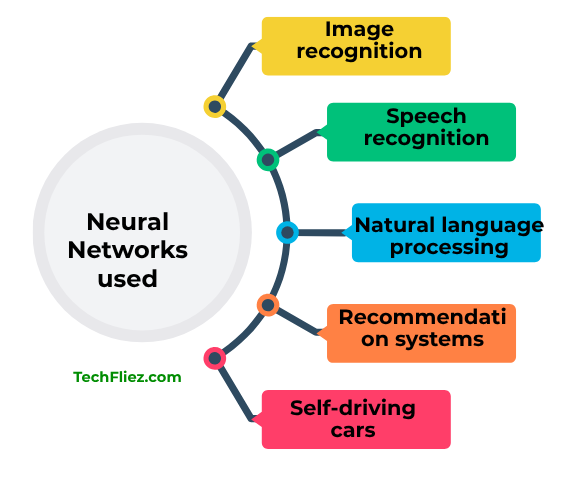
Neural networks are widely used in modern technology and power many AI applications such as:
- Image recognition
- Speech recognition
- Natural language processing
- Recommendation systems
- Self-driving cars
One of the main advantages of neural networks is their ability to learn complex relationships in large datasets, making them highly effective for solving real-world problems.
2. Syntax
Below is a simple Python example of creating a neural network using TensorFlow.
from tensorflow.keras.models import Sequential
from tensorflow.keras.layers import Dense

# Create neural network model
model = Sequential()

# Input layer and hidden layer
model.add(Dense(8, activation='relu', input_shape=(4,)))

# Hidden layer
model.add(Dense(6, activation='relu'))

# Output layer
model.add(Dense(1, activation='sigmoid'))

print("Neural Network Created")
This code creates a simple neural network with input, hidden, and output layers.
Output
After training the model and making predictions, the output might look like:
Prediction: [[0.82]]
This number represents the probability that the student will pass.
Explanation
Let’s understand how the neural network works step by step.
Step 1: Import Libraries
from tensorflow.keras.models import Sequential
from tensorflow.keras.layers import Dense
These libraries allow us to create and train neural networks.
Step 2: Create Model
model = Sequential()
The Sequential model allows layers to be added in sequence.
Step 3: Add Layers
model.add(Dense(8, activation='relu'))
Each Dense layer contains neurons that process input data.
Hidden layers help the model learn patterns and relationships in the dataset.
Step 4: Output Layer
The output layer generates the final prediction.
Step 5: Prediction
model.predict()
The model uses the learned patterns to predict results for new data.
3. Example
Let’s understand neural networks with a simple example.
Problem
Predict whether a student will pass or fail based on study hours.
Sample Dataset
| Study Hours | Result |
|---|---|
| 2 | Fail |
| 4 | Fail |
| 6 | Pass |
| 8 | Pass |
Steps
- Provide study hours as input to the neural network.
- The hidden layers analyze patterns in the data.
- The output layer predicts whether the student will pass or fail.
Example prediction:
prediction = model.predict([[5]])
print("Prediction:", prediction)
The neural network analyzes the input and produces a prediction based on the patterns it learned during training.
4. Real-World Example
Neural networks are used in many real-world applications.
1. Image Recognition
Neural networks can detect objects in images such as faces, animals, and vehicles.
Example: Face detection systems used in smartphones.
2. Voice Assistants
Virtual assistants like voice recognition systems use neural networks to convert speech into text and understand commands.
3. Recommendation Systems
Online platforms analyze user behavior using neural networks to recommend movies, products, or music.
4. Medical Diagnosis
Neural networks analyze medical images to detect diseases such as tumors or infections.
These real-world applications show how neural networks help computers perform tasks that normally require human intelligence.
5. Conclusion
Neural networks are a powerful technology in artificial intelligence and deep learning. They mimic the structure of the human brain and help machines learn from data to make predictions and decisions.
With the ability to process large datasets and identify complex patterns, neural networks are used in many modern applications such as image recognition, voice assistants, recommendation systems, and medical diagnosis.
Neural Networks Explained – Interview Questions
Q 1: What is a neural network?
Q 2: What are the main layers of a neural network?
Input Layer
Hidden Layers
Output Layer