
1. Introduction
Deep Learning is a specialized branch of Machine Learning that focuses on training artificial neural networks with multiple layers to analyze and learn complex patterns from large amounts of data. It is inspired by the structure and functioning of the human brain, where neurons process and transmit information.
Deep learning models can automatically learn features from raw data, making them extremely powerful for solving complex problems.
- Image recognition
- Speech recognition
- Natural language processing
- Self-driving cars
- Recommendation systems
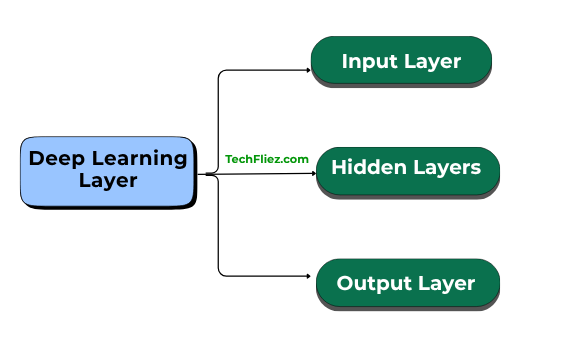
Deep learning models use Artificial Neural Networks (ANNs) that consist of multiple layers:
- Input Layer
- Hidden Layers
- Output Layer
The presence of multiple hidden layers is the reason it is called “Deep” Learning.
Deep learning requires large datasets and powerful computing resources such as GPUs to train models effectively. Today, it is widely used by major technology companies to build intelligent systems capable of performing tasks that were previously difficult for computers.
2. Syntax
Below is a simple Python example using a deep learning library to create a neural network model.
from tensorflow.keras.models import Sequential
from tensorflow.keras.layers import Dense

# Create model
model = Sequential()

# Add layers
model.add(Dense(10, activation='relu', input_shape=(4,)))
model.add(Dense(8, activation='relu'))
model.add(Dense(1, activation='sigmoid'))

# Compile model
model.compile(optimizer='adam', loss='binary_crossentropy', metrics=['accuracy'])

print("Deep Learning Model Created")
This syntax creates a simple neural network model with multiple layers.
Output
When running the earlier deep learning example, the output might look like this:
When the model is trained and predictions are made, the output could be:
Predicted Digit: 7
This means the model successfully recognized the handwritten digit.
Explanation
Let’s understand how the deep learning code works.
Step 1: Import Libraries
from tensorflow.keras.models import Sequential
from tensorflow.keras.layers import Dense
These libraries help create neural networks.
Step 2: Create Model
model = Sequential()
The Sequential model allows layers to be added one after another.
Step 3: Add Layers
model.add(Dense(10, activation='relu'))
Each layer contains neurons that process input data.
Hidden layers help the model learn complex patterns.
Step 4: Compile Model
model.compile(optimizer='adam', loss='binary_crossentropy')
The model is configured with:
- Optimizer – improves learning
- Loss function – measures prediction error
Step 5: Model Prediction
model.predict()
After training, the model predicts results using new data.
3. Example
Let’s understand deep learning with a simple example.
Suppose we want to build a system that can recognize handwritten digits from images.
Dataset
Each image contains a handwritten digit between 0 and 9.
Steps
- Collect a dataset of handwritten digit images.
- Train a deep learning neural network on the dataset.
- The model learns patterns in the images.
- The trained model predicts the digit when a new image is provided.
Example prediction code:
prediction = model.predict(image)
print("Predicted Digit:", prediction)
The deep learning model analyzes the image and predicts the correct number.
4. Real-World Example
Deep learning is widely used in many real-world applications.
1. Image Recognition
Deep learning models are used to identify objects, faces, and animals in images.
Example:
Photo tagging systems in social media platforms.
2. Speech Recognition
Voice assistants use deep learning to understand spoken language.
Examples include systems that convert speech to text.
3. Self-Driving Cars
Autonomous vehicles use deep learning to detect:
- Roads
- Traffic signs
- Pedestrians
- Vehicles
This helps the car navigate safely.
4. Medical Diagnosis
Deep learning models analyze medical images such as:
- X-rays
- MRI scans
- CT scans
Doctors use these models to detect diseases like cancer at an early stage.
5. Conclusion
Deep Learning is one of the most powerful technologies in artificial intelligence. It enables computers to analyze large amounts of data and learn complex patterns automatically using neural networks.
This technology is transforming industries such as healthcare, transportation, finance, and entertainment. From speech recognition to self-driving cars, deep learning is helping create smarter systems that can solve complex real-world problems.