
1. Introduction
In Artificial Intelligence, Supervised Learning is one of the most popular and widely used types of machine learning.
How to use Supervised Learning in Machines ?
It is used to train machines using labeled datasets so that they can learn patterns and make predictions.
In supervised learning, the algorithm learns from input-output pairs. This means that the training dataset already contains the correct answers, also known as labels.
Example: if we want to train a model to detect spam emails, we provide a dataset where emails are labeled as spam or not spam. The algorithm learns patterns from this labeled data and then predicts whether new emails are spam or not.
2. Syntax
Python Language is used to implement Supervised learning algorithms and machine learning libraries such as Scikit-learn.
Below is a basic syntax example using a Linear Regression model.
from sklearn.linear_model import LinearRegression

# Training data
X = [[1], [2], [3], [4]]
y = [2, 4, 6, 8]

# Create model
model = LinearRegression()

# Train model
model.fit(X, y)
# Predict output
prediction = model.predict([[5]])
print(prediction)   // Output: 10
This code trains a model using labeled data and then predicts the output for a new input.
Training data
X = [[1], [2], [3], [4]]
y = [2, 4, 6, 8]
This represents the relationship:
| X | y |
|---|---|
| 1 | 2 |
| 2 | 4 |
| 3 | 6 |
| 4 | 8 |
So the pattern is:
y=2x
3. Example
Let’s look at a simple supervised learning example where a model predicts house prices based on house size.
Python Example
from sklearn.linear_model import LinearRegression

# House sizes
size = [[500], [800], [1000], [1200]]

# House prices
price = [100000, 160000, 200000, 240000]

# Create model
model = LinearRegression()

# Train model
model.fit(size, price)

# Predict price
prediction = model.predict([[900]])

print("Predicted Price:", prediction)
Step 1: Understand the Training Data
| House Size (sq ft) | Price ($) |
|---|---|
| 500 | 100000 |
| 800 | 160000 |
| 1000 | 200000 |
| 1200 | 240000 |
So the relationship learned by the model is approximately:
Price=200×Size
Step 2: Prediction
The model predicts for:
size = 900
Price=200×Size
Price = 200×900
Price=180000
In this example, the algorithm learns the relationship between house size and price using labeled data.
Output
This output shows the predicted house price based on the given input.
Explanation
Let’s understand the code step by step.
1. Import Library
from sklearn.linear_model import LinearRegression
This imports the Linear Regression algorithm.
2. Define Dataset
size = [[500], [800], [1000], [1200]]
price = [100000, 160000, 200000, 240000]
The dataset contains input values (house size) and output values (price).
3. Create Model
model = LinearRegression()
This creates the machine learning model.
4. Train Model
model.fit(size, price)
The model learns the relationship between size and price.
5. Predict Output
The model predicts the house price based on the input value.
4. Real-world Example
Supervised learning is used in many real-world applications.
1. Email Spam Detection
Email services use supervised learning to detect spam messages.
The model is trained using labeled datasets containing spam and non-spam emails.
2. Recommendation Systems
Streaming platforms like Netflix use supervised learning algorithms to recommend movies based on user viewing history.
3. E-commerce Product Recommendations
Online marketplaces such as Amazon analyze customer behavior data to suggest relevant products.
4. Voice Recognition Systems
Voice assistants such as Google Assistant and Siri use supervised learning models to recognize and interpret speech.
Types of Supervised Learning
Supervised learning can be divided into two main categories.
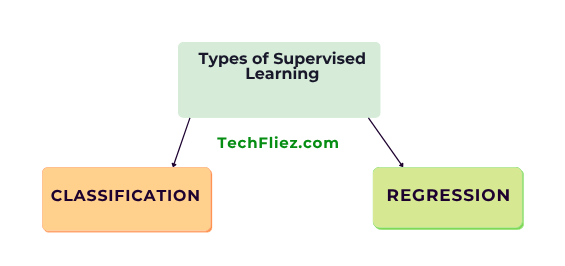
1. Classification
Classification algorithms predict categories or labels.
Examples include:
- Spam detection
- Image recognition
- Disease diagnosis
Popular classification algorithms:
- Decision Trees
- Support Vector Machines
- Logistic Regression
2. Regression
Regression algorithms predict numerical values.
Examples include:
- House price prediction
- Sales forecasting
- Stock price prediction
Popular regression algorithms:
- Linear Regression
- Polynomial Regression
- Random Forest Regression
Advantages of Supervised Learning
There are lots of advantages when we use Supervised Learning
- It is very easy to understand and implement.
- It produces accurate predictions when trained with quality data.
- It is widely used in real-world applications.
- It supports both classification and regression problems.
Limitations of Supervised Learning
supervised learning also has some limitations.
- It requires large labeled datasets.
- Data labeling can be expensive and time-consuming.
- Performance depends heavily on data quality.
8. Conclusion
Supervised learning is one of the most fundamental techniques in Artificial Intelligence and machine learning. It allows computers to learn from labeled data and make accurate predictions.
There are some example of Supervised learning as spam detection, recommendation systems, speech recognition, and predictive analytics.