
1. Introduction
Artificial Intelligence (AI) require human intelligence to perform the task.
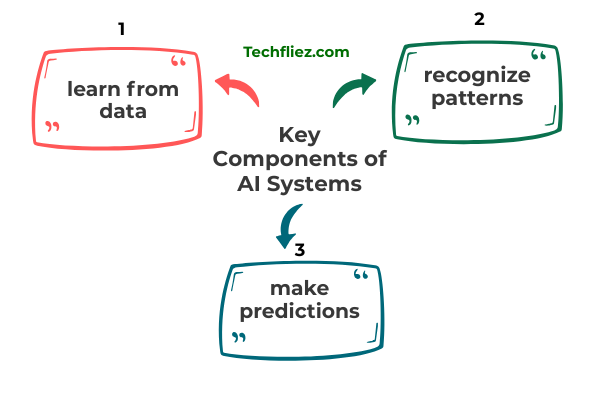
AI systems work process flow in 3 steps
- learn from data
- recognize patterns
- make predictions
As you know, AI does not work on its own. It relies on several key components that work together to build intelligent systems.
These components allow AI models to process data, learn patterns, and generate accurate results.
In simple terms, AI systems work by collecting data, processing it, training machine learning models, and using those models to make predictions or decisions.
2. Example
Suppose we want to build an AI system that predicts the size of a pizza based on its diameter and number of slices.
Python Example
from sklearn.tree import DecisionTreeClassifier

# Pizza data
features = [
   [8,4],
   [10,6],
   [12,8],
   [16,12]
]

labels = ["Small", "Medium", "Large", "Extra Large"]

# Create model
model = DecisionTreeClassifier()

# Train model
model.fit(features, labels)

# Predict pizza size
result = model.predict([[11,6]])

print("Predicted Pizza Size:", result[0])
This example shows how an AI model learns from previous data and predicts results for new inputs.
Output
Output of the pizza prediction example:
This output indicates that the AI model predicted the pizza size based on the input data.
Explanation
Let’s understand how the AI system works step by step.
1. Import Library
from sklearn.tree import DecisionTreeClassifier
This imports a machine learning algorithm.
2. Training Data
features = [[8,4],[10,6],[12,8],[16,12]]
labels = ["Small","Medium","Large","Extra Large"]
Here:
- Features represent input values.
- Labels represent expected outputs.
3. Model Creation
model = DecisionTreeClassifier()
This creates the machine learning model.
4. Model Training
model.fit(features, labels)
The model learns patterns from the training data.
5. Prediction
model.predict([[11,6]])
The AI model predicts the output using new input values.
3. Real-world Example
AI systems power many real-world applications that people use daily.
1. Recommendation Systems
Streaming services like Netflix use AI to recommend movies and shows based on user behavior.
The AI system analyzes:
- Viewing history
- Ratings
- User preferences
Then it predicts which content the user may enjoy.
2. E-commerce Recommendations
Online stores like Amazon use AI algorithms to recommend products.
These recommendations appear as:
- “Customers also bought”
- “Recommended for you”
AI analyzes browsing history and purchasing behavior to generate suggestions.
3. Voice Assistants
Voice assistants like Google Assistant and Siri use AI to understand voice commands.
They rely on Natural Language Processing (NLP) to interpret human speech and respond appropriately.
4. Self-Driving Cars
Companies such as Tesla are developing self-driving vehicles using AI systems.
These systems use sensors, cameras, and machine learning algorithms to detect roads, traffic signs, and obstacles.
4. Key Components of AI Systems
Artificial Intelligence systems are the combination of several important components. Components work together to collect data, learn patterns, and make predictions.
Each component plays a important role in ensuring the AI system functions efficiently and produces accurate results.
I will show you some important components.
1. Data
Data is the vital role of every AI system. Without data, an AI model cannot learn or make predictions.
AI systems learn patterns by analyzing large amounts of data such as:
- Images
- Text documents
- Audio or video files
- User behavior and activity data
For example, an image recognition AI system learns by analyzing thousands of labeled images. The quality, accuracy, and quantity of data directly affect how well the AI model performs.
Note: If the dataset is incomplete or biased, the AI system may produce incorrect predictions.
2. Algorithms
There are many Algorithms are used in AI systems. It is a mathematical rules and procedures that allow AI systems to analyze data and learn patterns.
These algorithms process input data, identify relationships, and generate predictions or decisions.
Some commonly used AI algorithms include:
- Decision Trees
- Neural Networks
- Support Vector Machines (SVM)
- K-Nearest Neighbors (KNN)
Different algorithms are used depending on the type of problem.
Example:
- some algorithms are better for classification tasks.
- some algorithms are better for prediction or pattern recognition.
3. Machine Learning Models
A machine learning model is the result of training an algorithm using data.
Training Information:
- During the training process: the algorithm analyzes the dataset and learns relationships between inputs and outputs.
- After training: The model can use this learned knowledge to make predictions on new, unseen data.
For example, a trained AI model can:
- Predict house prices
- Detect spam emails
- Recommend movies to users
The better the training process and dataset, the more accurate the model becomes.
4. Computing Power
If there is need to process large datasets and train complex models then AI systems require strong computing resources.
Training advanced AI models may require powerful hardware such as:
- CPUs (Central Processing Units)
- GPUs (Graphics Processing Units)
- Cloud computing infrastructure
GPUs are especially important for tasks such as deep learning because they can process many calculations simultaneously. High computing power helps AI systems train faster and handle more complex problems.
5. Data Processing and Preprocessing
Raw data is often messy and cannot be used directly for training AI models. Therefore, it must go through a preprocessing stage.
Data preprocessing involves preparing and cleaning the data before feeding it into the model.
There are some common preprocessing steps include:
- Removing duplicate or incorrect data
- Handling missing values
- Normalizing or scaling numerical data
- Converting text or categorical data into numerical format
Note: Proper data preprocessing improves the accuracy and reliability of AI models.
6. Evaluation and Testing
After training the model, it is important to evaluate how well it performs.
Evaluation helps determine whether the AI model can make accurate predictions when given new data. This process usually involves testing the model using a separate dataset that was not used during training.
Common evaluation methods include measuring:
- Accuracy
- Precision
- Recall
- Error rate
If the results are not satisfactory, developers may adjust the model, change the algorithm, or provide more training data to improve performance.
5. Conclusion
To create intelligent applications, Artificial Intelligence systems rely on several key components that work together.
Some components like Data, algorithms, machine learning models, computing power, and evaluation processes all play an important role in building effective AI systems.