
1. Introduction
Machine Learning is a part of Artificial Intelligence that enables computers to learn from data and improve their performance without explicit programming.
Machine learning systems is used to analyze data, identify patterns, and make predictions or decisions, Instead of following fixed instructions.
Machine Learning is widely used in many modern technologies such as recommendation systems, fraud detection, voice assistants, and self-driving cars.
2. Types of Machine Learning
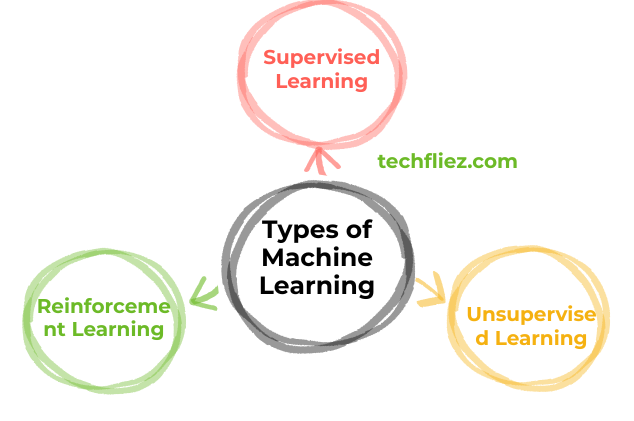
There are three main types of Machine Learning:
- Supervised Learning
- Unsupervised Learning
- Reinforcement Learning
Each type works differently depending on the kind of data available and the problem being solved.
- If the data has labels, supervised learning is used.
- If the data has no labels, unsupervised learning is used.
- If the system learns through rewards and penalties, reinforcement learning is used.
Understanding these types is important because it helps developers and data scientists choose the right machine learning approach for a specific problem.
3. Syntax
Below is a basic Python syntax example demonstrating a supervised learning model using the Scikit-Learn library.
from sklearn.linear_model import LinearRegression

# Training data
X = [[1], [2], [3], [4]]
y = [10, 20, 30, 40]

# Create model
model = LinearRegression()

# Train the model
model.fit(X, y)

# Make prediction
prediction = model.predict([[5]])

print(prediction)
This example demonstrates how a machine learning model learns from input data and predicts new values.
Output:
This output represents the predicted value based on the trained machine learning model.
For example, if the system learns that:
1 → 10
2 → 20
3 → 30
4 → 40
Then the prediction for 5 may be close to 50.
Explanation
Let’s understand how the machine learning code works step by step.
1. Import Library
from sklearn.linear_model import LinearRegression
This line imports the Linear Regression algorithm used for supervised learning.
Provide Training Data
X = [[1], [2], [3], [4]]
y = [10, 20, 30, 40]
- X represents input data.
- y represents output values.
This dataset is used to train the model.
2. Create Model
model = LinearRegression()
This creates a machine learning model.
3. Train Model
model.fit(X, y)
The fit() function trains the model using the provided dataset.
4. Make Prediction
model.predict([[5]])
After training, the model can predict new values based on learned patterns.
4. Example
Let’s look at examples of each type of machine learning.
1. Supervised Learning Example
In supervised learning, the model learns from labeled data.
Example dataset:
| Study Hours | Exam Score |
|---|---|
| 2 | 40 |
| 4 | 55 |
| 6 | 70 |
| 8 | 85 |
The machine learning model learns the relationship between study hours and exam scores and predicts the score for new inputs.
2. Unsupervised Learning Example
In unsupervised learning, the data does not contain labels. The algorithm finds patterns in the data.
Example:
A shopping website analyzes customer purchase behavior and groups customers into different categories such as:
- Frequent buyers
- Occasional buyers
- Discount seekers
This technique is commonly called clustering.
3. Reinforcement Learning Example
In reinforcement learning, an agent learns through trial and error.
For example:
A robot learns to walk.
If it takes a correct step → it receives a reward.
If it falls → it receives a penalty.
Over time, the robot learns the best way to walk.
5. Real-World Example
Machine learning types are used in many real-world applications.
1. Supervised Learning Applications
- Email spam detection
- Stock price prediction
- Medical diagnosis
- Image classification
Example: A system trained with thousands of labeled images can detect whether an image contains a cat or a dog.
2. Unsupervised Learning Applications
- Customer segmentation
- Market analysis
- Anomaly detection
- Recommendation systems
Example: Online stores group customers based on their purchasing habits.
3. Reinforcement Learning Applications
- Self-driving cars
- Game playing AI
- Robotics
- Traffic signal optimization
Example: AI programs that play chess or video games learn strategies by receiving rewards when they win.
6. Conclusion
Machine Learning is an important technology. There are three types of Machine Learning.
Supervised learning works with labeled data and is commonly used for predictions and classification tasks.
Unsupervised learning finds hidden patterns in data without labels, making it useful for clustering and segmentation.
Reinforcement learning allows systems to learn through rewards and penalties, which is widely used in robotics and gaming AI.
Understanding these types helps developers choose the right approach when building intelligent systems. As technology continues to evolve, machine learning will play an even bigger role in industries such as healthcare, finance, automation, and data science.
Types of Machine Learning – Interview Questions
Q 1: What are the main types of Machine Learning?
Supervised Learning
Unsupervised Learning
Reinforcement Learning