
Java Architecture is the design structure that allows Java programs to run on any platform or device. It is based on the idea of writing code once and running it anywhere. At a high level, Java’s architecture consists of several components, each playing a crucial role in enabling Java programs to run efficiently and reliably.
Components of Java Architecture
The Java Architecture consists of the following key components:
Java Development Kit (JDK)
The JDK provides the tools necessary for developing Java applications. It includes the following:
- Java Compiler (javac): Converts Java source code into bytecode.
- Java Runtime Environment (JRE): Contains the necessary libraries and the JVM to execute Java applications.
- Java Debugger: Helps developers to debug Java code.
Java Runtime Environment (JRE)
The JRE includes everything required to run Java applications:
- JVM (Java Virtual Machine): The JVM is the core of Java’s architecture. It is responsible for executing Java bytecode.
- Java Class Libraries: These libraries provide standard functionality like I/O operations, networking, utilities, etc.
Java Virtual Machine (JVM)
The JVM is a virtual machine that enables the execution of Java bytecode on any device or operating system. The JVM provides:
- Garbage Collection: Automatic memory management, freeing up memory when it’s no longer in use.
- Execution Engine: Executes bytecode instructions in the form of machine code for a specific platform.
- Class Loader: Loads classes into memory when needed.
Bytecode
Java source code is compiled into an intermediate form called bytecode. Bytecode is platform-independent and is executed by the JVM.
Java API (Application Programming Interface)
The Java API is a collection of pre-written classes and methods that help developers create Java applications without having to code everything from scratch.
JIT Compiler
The Just-In-Time (JIT) compiler improves the performance of Java applications by compiling bytecode into native machine code at runtime, which can be executed directly by the system’s CPU.
Java Architecture Diagram
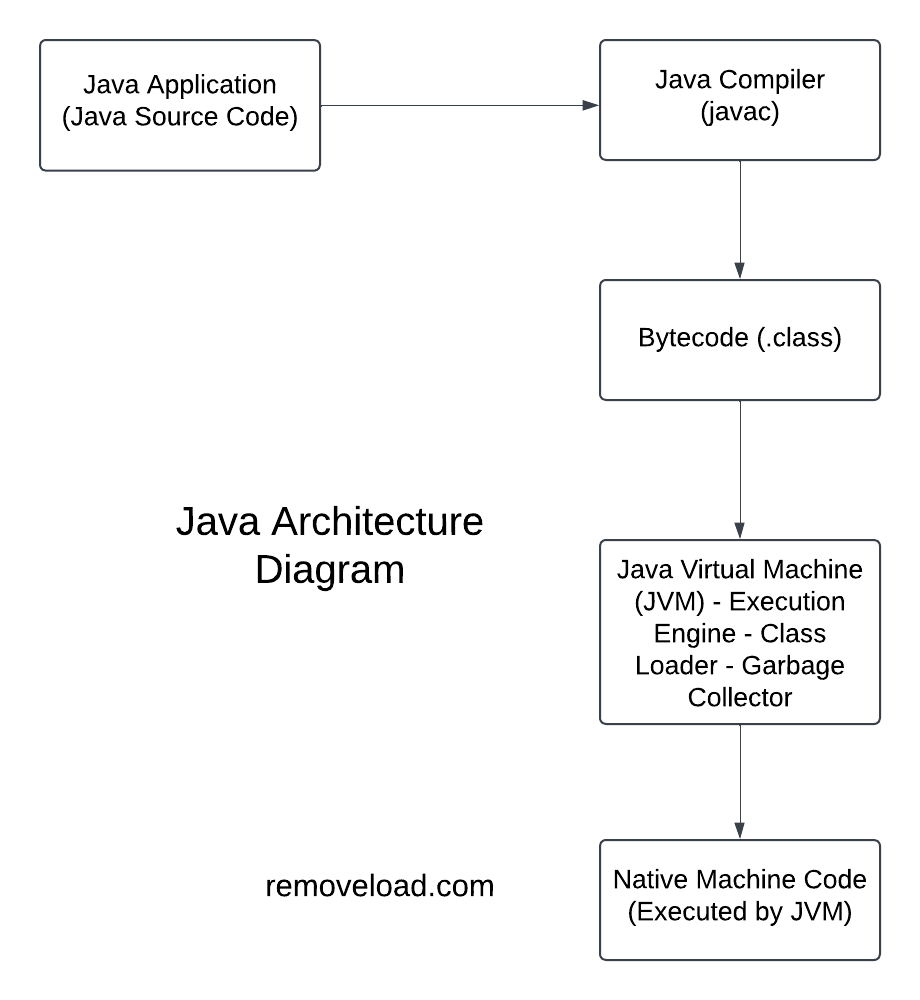
Java Architecture Code Process
1. Write Java Code (Source Code)
public class SourceCodeExample {
    public static void main(String[] args) {
        System.out.println("Hello World!");
    }
}
2. Compile Java Code
The developer compiles this code using the javac command.
javac SourceCodeExample.java
This command produces a file called SourceCodeExample.class, which contains the bytecode representation of the program.
3. Run Bytecode on JVM
The compiled bytecode is executed by the JVM using the java command:
java SourceCodeExample
The JVM loads the SourceCodeExample.class bytecode file, interprets it, and executes the program. The output will be:
Java Architecture – Interview Questions
Q 1: What are the main components of Java architecture?
Q 2: What is the function of Class Loader?
Q 3: What is JIT Compiler?
Q 4: What is Java API?
Q 5: What is runtime data area?
Java architecture – Objective Questions (MCQs)
Q1. Which of the following components is responsible for converting Java bytecode into machine code?
Q2. What is the correct sequence of the Java architecture components for program execution?
Q3. Which component of Java architecture provides the libraries and runtime environment for Java programs?
Q4. The Just-In-Time (JIT) compiler in Java is used to:
Q5. Which of the following statements about JVM is TRUE?