
addEventListener in JavaScript

Introduction:

In this article, you will learn the concept of addEventListener, which is a DOM method.

What is addEventListener?

addEventListener() is a DOM method and it is used to attach an event handler to an element.

Old way


<button onclick="handleClick()">Click</button>

In Modern JavaScript use:


button.addEventListener("click", handleClick);

Note: You can keep JavaScript separate from HTML, which is a best practice.

Basic Syntax


element.addEventListener(event, function, options);

Explained

event: Type of event (click, mouseover, keydown, etc.).

function: Callback function that runs when the event occurs.

options: Optional (capture, once, passive).

Basic Example


<button id="btn">Click Me</button>
<script>
  const button = document.getElementById("btn");
  button.addEventListener("click", function() {
    alert("Button Clicked!");
  });
</script>

When the button is clicked, the function runs.

Why Use addEventListener Instead of onclick?

Feature addEventListener onclick
Multiple Handlers Yes No
Separation of Concerns Yes No
Modern Practice Yes Outdated
Remove Event Easily Yes Limited

Multiple Event Listeners Example


button.addEventListener("click", function() {
  console.log("First handler");
});

button.addEventListener("click", function() {
  console.log("Second handler");
});

Note: both functions will be called when you click the button.

Some Common Events You Should Know
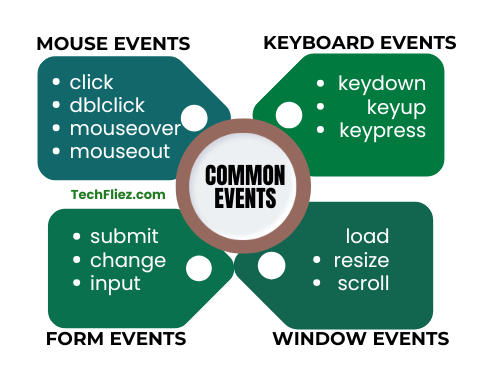
Mouse Events

  • click
  • dblclick
  • mouseover
  • mouseout

Keyboard Events

  • keydown
  • keyup
  • keypress

Form Events

  • submit
  • change
  • input

Window Events

  • load
  • resize
  • scroll

Event Object

The callback function receives an event object.

Example:


button.addEventListener("click", function(event) {
  console.log(event.target);
});

The event object contains:

  1. Target
  2. Type
  3. preventDefault()
  4. stopPropagation()

❌ Removing Event Listener

To remove an event, you must use the same function reference.


function handleClick() {
  console.log("Clicked");
}
button.addEventListener("click", handleClick);
button.removeEventListener("click", handleClick);

Note: Anonymous functions cannot be removed.

Common Beginner Mistakes

Calling the function immediately


button.addEventListener("click", handleClick()); // Wrong

✅ Correct way


button.addEventListener("click", handleClick);

Event Bubbling & Capturing in JavaScript

In this article, you will clear the concept of Event Bubbling & Capturing.

If you don’t understand Event Bubbling and Capturing, you’ll eventually face unexpected bugs in JavaScript.

What is Event Propagation?

Event propagation defines how events travel in the DOM tree.

When an event occurs, it doesn’t just happen on one element. It moves through the DOM in three phases:

  1. Capturing Phase
  2. Target Phase
  3. Bubbling Phase

 Capturing Phase

The event starts from the root (document) and travels down to the target element.

document → html → body → parent → child

Target Phase

The event reaches the actual element that was clicked.

Bubbling Phase (Default Behavior)

The event bubbles back up from the target to the root.

child → parent → body → html → document

Note: By default, JavaScript uses the bubbling phase.

Example of Event Bubbling

HTML:


<div id="parent">
  <button id="child">Click Me</button>
</div>

JavaScript:


document.getElementById("parent").addEventListener("click", function() {
  console.log("Parent clicked");
});
document.getElementById("child").addEventListener("click", function() {
  console.log("Child clicked");
});

Output:

Child clicked

Parent clicked

Example of Event Capturing

To enable capturing, pass true as the third parameter.


document.getElementById("parent").addEventListener("click", function() {
  console.log("Parent clicked");
}, true);

Output:

Parent clicked

Child clicked

Note: the event is captured before reaching the target.

Bubbling vs Capturing

Feature Event Bubbling Event Capturing
Direction Child → Parent Parent → Child
Default Behavior Yes No
addEventListener Third Parameter false (default) true
Use Case Event Delegation Special Control Cases

How to Stop Event Bubbling

You can stop event bubbling through below method.

Syntax:


event.stopPropagation();

Example:


document.getElementById("child").addEventListener("click", function(event) {
  event.stopPropagation();
  console.log("Child clicked only");
});

Note: Now the parent event will NOT fire.

Real-World Use Case: Event Delegation

Event bubbling makes event delegation, you can check below example


document.getElementById("list").addEventListener("click", function(e) {
  if (e.target.tagName === "LI") {
    console.log("List item clicked");
  }
});

Note: This improves performance in large applications.

When Should You Use Capturing?

Capturing is rarely used. You can use

  1. You want parent logic before child logic.
  2. Handling complex UI interactions

❌ Confusing stopPropagation and preventDefault

stopPropagation() → It is used to stop bubbling.

preventDefault() → It stops default browser behavior.

Interview Questions

Q 1: What is addEventListener in JavaScript?

Ans: addEventListener() is a DOM method and it is used to attach an event handler to an element. It allows you to run a function when a specific event occurs, such as a click, hover, or key press.

Q 2: What is the syntax of addEventListener?

Ans: element.addEventListener(event, function, useCapture);

Q 3: What is the difference between addEventListener and onclick?

Ans: addEventListener: It allows multiple event handlers on the same element.
onclick: It allows only one event handler.
addEventListener provides more flexibility and better control over event handling.

Q 4: Can we remove an event listener in JavaScript?

Ans: Yes, we can remove an event listener using the removeEventListener() method.
Example: element.removeEventListener("click", myFunction);

Q 5: Why is addEventListener preferred in modern JavaScript development?

Ans: Because it supports multiple events, better event management, and follows modern JavaScript standards.

Conclusion

The addEventListener is an important DOM method. Developers can attach multiple events to elements and handle them efficiently. If you compare older event-handling methods like onclick, addEventListener offers greater flexibility and better control over how events are managed.

Understanding how to use addEventListener properly will help you create more interactive and dynamic web applications.