
Introduction
In this tutorial, you will learn about JavaScript promises vs async/await.
JavaScript provides Promises and async/await to handle asynchronous operations like API calls, database queries, etc.
What is a Promise?
Promise is used to handle asynchronous operations. It has three states.
- Pending
- Fulfilled
- Rejected
Note: We use Promises, when you need parallel execution,
Example 1:
const data = new Promise((resolve, reject) => {
  setTimeout(() => {
    resolve("Data received");
  }, 2000);
});
Example 2:
fetch(url)
  .then(res => res.json())
  .then(data => console.log(data))
  .catch(error => console.log(error));
What is async/await?
async/await is used to handle asynchronous operations. It makes async code look like synchronous code.
Example:
async function fetchData() {
  const data = await fetch(url);
  return data;
}
Difference between Promises vs async/await
| Promises | async/await |
|---|---|
| In the syntax, it has .then() | In the syntax, It has await |
| It is more complex to read | It is very Cleaner & readable |
| Debugging is very hard. | Debugging is very easy. |
| Prmises has chaining. | There is no need chaining in async/await |
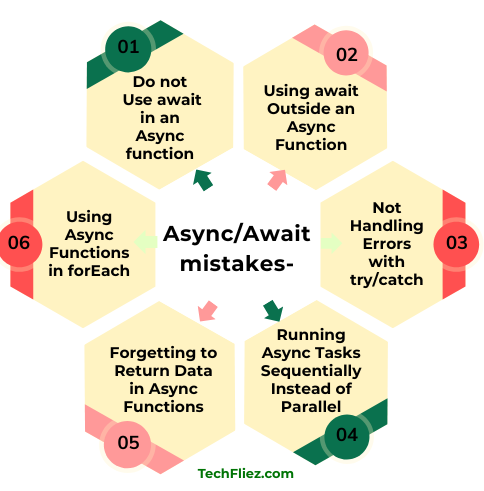
What is the common mistake in async/await
A developer can make a mistake when using async/await.
1. Using await without async.
2. Using forEach with async/await.
3. Forgetting error handling.
Real-Life Example: Fetching User Data from an API
Suppose you need to fetch user information from a server API. This is an asynchronous task because the data comes from a remote server.
Example Using Promises
function getUser() {
  return fetch("https://api.example.com/user")
    .then(response => response.json())
    .then(data => {
      console.log("User Data:", data);
    })
    .catch(error => {
      console.error("Error:", error);
    });
}
getUser();
Example Using async/await
async function getUser() {
  try {
    const response = await fetch("https://api.example.com/user");
    const data = await response.json();
    console.log("User Data:", data);
  } catch (error) {
    console.error("Error:", error);
  }
}
getUser();
Explanation:
Both examples perform the same task: fetching user data from an API.
- Promises use .then() and .catch() to handle results and errors.
- async/await allows you to write asynchronous code in a synchronous looking style.
- await pauses the execution of the function until the promise resolves.
- Error handling becomes cleaner with try…catch.
Note: In Modern JavaScript, async/await is usually preferred because it improves readability and code easier to manage.
Interview Questions
Q 1: What is the difference between Promises and async/await in JavaScript?
Q 2: Does async/await replace Promises in JavaScript?
Q 3: When should you use Promises instead of async/await?
Q 4: Can we use await without async?
Conclusion
Both Promises and async/await are used to handle asynchronous operations in JavaScript.
In most modern applications, developers prefer async/await because it simplifies complex asynchronous logic and makes the code easier to maintain. However, understanding Promises is still important, since async/await is built on top of them and many libraries still use promise-based patterns.